PET HEALTH · CONSUMER INVESTIGATION
They're Not Selling a Cure. They're Selling a Subscription.
Monthly boxes, auto-ship and "consistency is key." Over 100,000 dog parents have stopped paying every month and take the tartar off at home instead.

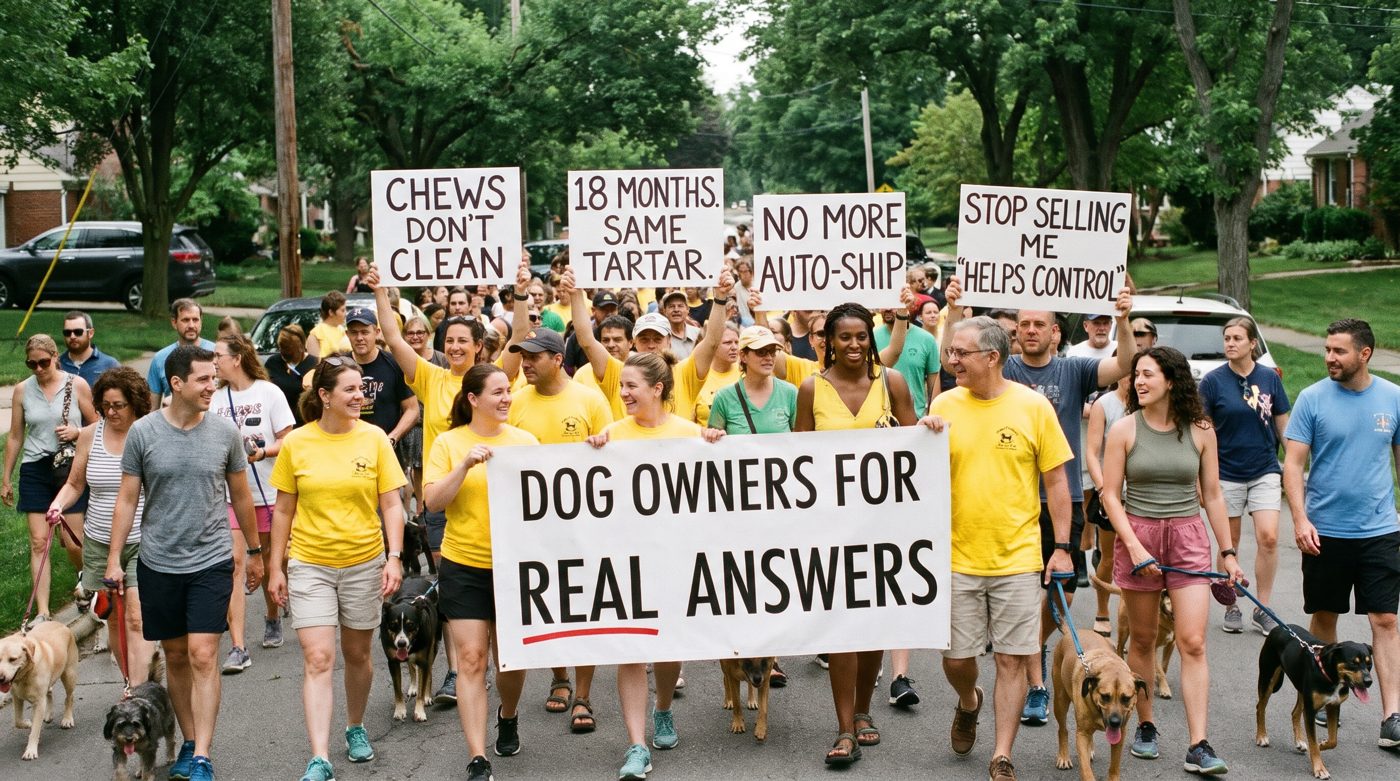
"Just give him one every day."
You've heard it from the pet store, the back of the bag, sometimes the clinic itself.
"Give him a dental chew every day, it scrapes the teeth while he chews."
"Add a capful of this to the water bowl, it does the work for you."
"Consistency is the key."
So you bought the chews, then the additive, the powder and the enzyme toothpaste. Some months you were spending more on your dog's mouth than on your own.
And the tartar is still there.
Lift his lip and look at the back teeth. That yellow-brown crust climbing toward the gum line was there six months ago, and it will be there after the next bag.
Then the vet looks in his mouth and says the sentence nobody budgets for: "He's going to need a dental cleaning. We'll put him under." With general anesthesia, that quote often runs $500 to $1,500 once X-rays and extractions are added.
Something has to explain all of it.
When millions of dogs use these products daily and still end up on the same table, the problem is not the owners. Something in the way these products are designed, sold and renewed keeps the purchase coming back every month while the tartar stays exactly where it is.
EVIDENCE · 01
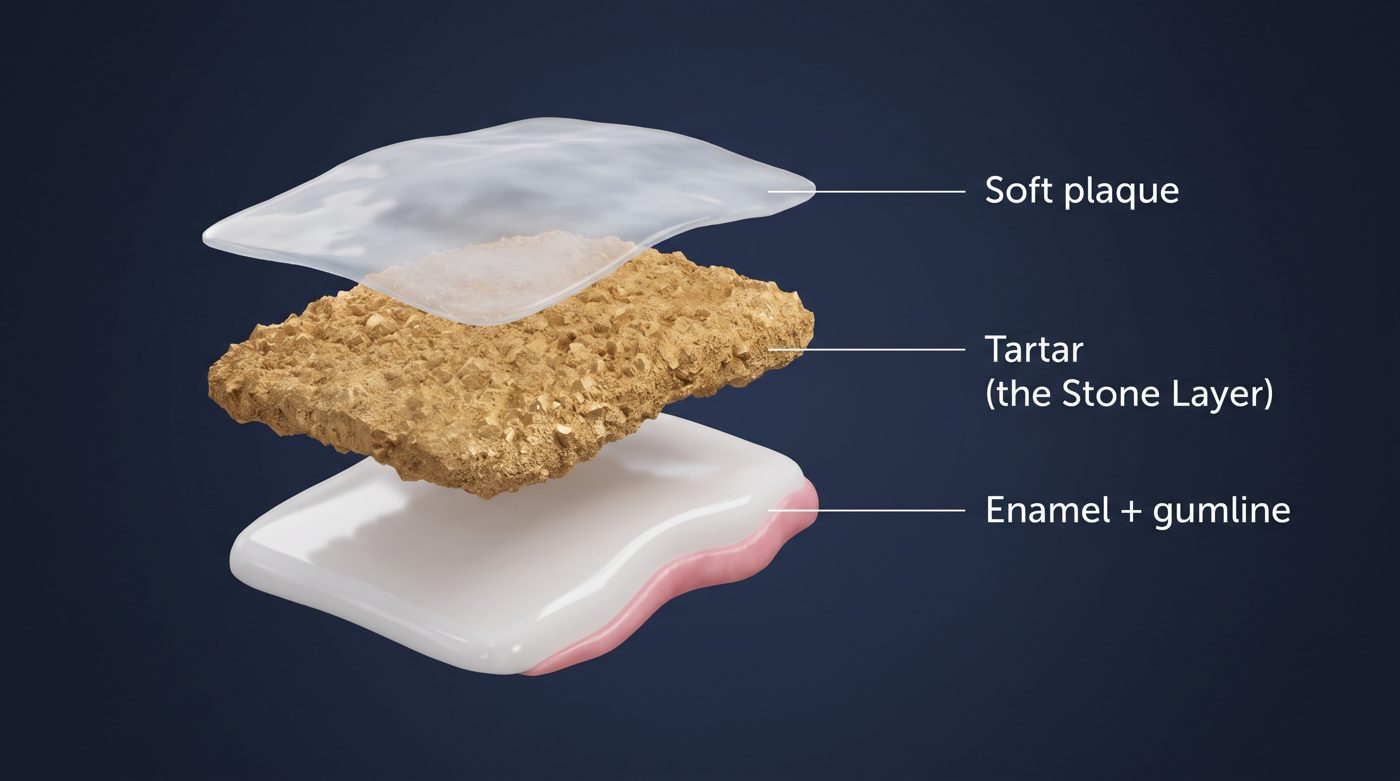
Plaque left on the tooth starts hardening into tartar within about three days, a Stone Layer bonded to the tooth like scale inside a kettle.
Nothing your dog chews, drinks or eats will dissolve it.
Merck Veterinary Manual, "What is plaque?"
EVIDENCE · 02
The industry's own seal goes to products that "help control plaque" or "help control tartar," not to products that remove it.
They slow new build-up and do not claim to remove tartar that has already hardened.
Veterinary Oral Health Council, product acceptance protocol, vohc.org.
EVIDENCE · 03
To earn the seal, a product only has to slow build-up by at least 20% on average, with at least 15% in each of two trials.
A dog on a sealed product can still build up as much as four-fifths of the tartar he would have built anyway.
VOHC, Trial Protocol, Detailed Requirements.
EVIDENCE · 04
A 10% or 20% reduction on its own will not prevent periodontal disease in a dog who is predisposed to it.
That's a veterinary dentist, writing about the seal itself.
Hale F., Canadian Veterinary Journal, 2011;52(4):437-438.
EVIDENCE · 05
In 22,333 dogs under primary vet care in the UK, the one-year prevalence of periodontal disease was 12.52%, about one dog in eight.
The Royal Veterinary College calls it by far the most commonly diagnosed disorder in UK dogs.
O'Neill et al., Journal of Small Animal Practice, 2021, 62(12):1051-1061.
EVIDENCE · 06
Dogs under 15 kg (about 33 lb) were 2.5 times as likely to be affected as dogs of 30 to 40 kg, and dogs aged eight and over more than three times as likely as dogs aged two to four.
Toy Poodles had the highest breed odds, at 3.97.
O'Neill et al., JSAP, 2021; Royal Veterinary College, Clinical Connections, Autumn 2021.
EVIDENCE · 07
About 1 in 600 dogs (0.17%) died from anesthesia-related causes within 48 hours, rising to 1.33% (about 1 in 75) in sick or higher-risk dogs.
The CEPSAF study followed more than 98,000 dogs anesthetized in UK practices.
Brodbelt et al., Veterinary Anaesthesia and Analgesia, 2008.
EVIDENCE · 08
Nearly half of anesthetic deaths in dogs (47%) happened after the procedure was over, in recovery.
That's when the owner thinks the hard part is over.
Brodbelt et al., Veterinary Anaesthesia and Analgesia, 2008.
The model nobody explains to the customer
A product that removes tartar is something you buy once. A product that helps control tartar has to be bought again tomorrow, because plaque comes back every day and starts hardening within about three days.
That is why every bag, bottle and jar comes with the same instruction, "use daily, for life," and why so many put a "subscribe & save" option next to the buy button.
Picture dried concrete on a windshield: the chews are the wipers, you keep paying for new blades, and the concrete never moves.
Add it up
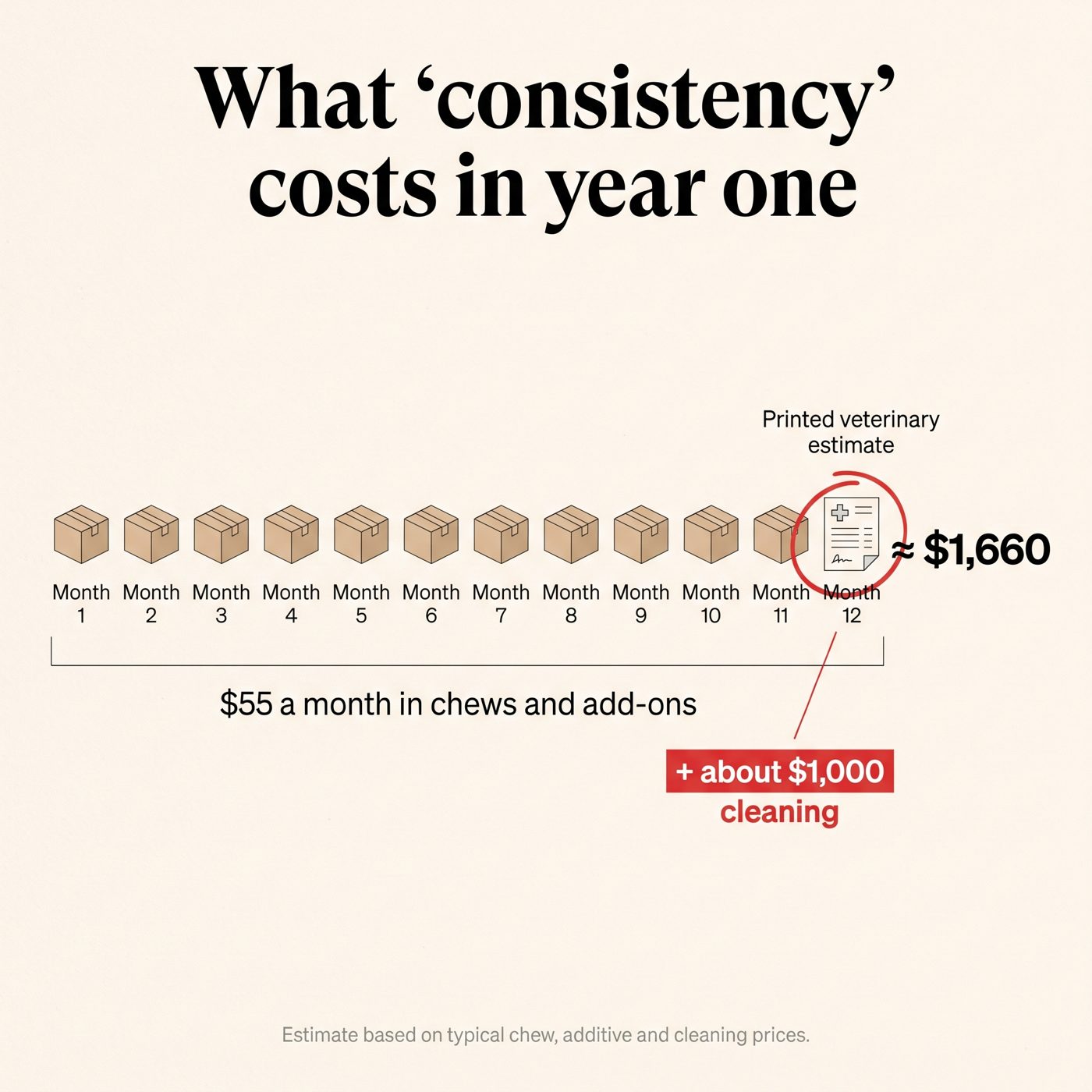
Here's what the "consistency" route costs, using average US retail prices (estimates, your exact numbers will vary with brand and dog size):
- Daily dental chews: about $1 a chew for a medium dog, so around $30 a month
- One add-on (powder, topper or water additive): around $25 a month
- Typical stack: about $55 a month, or $660 a year
- Professional cleaning under anesthesia: often $500 to $1,500 once X-rays and extractions are added, so call it $1,000 as a middle figure
- Over 1 year: $660 in chews and add-ons, plus one cleaning, about $1,660
- Over 3 years: $1,980 in chews and add-ons, plus two cleanings, about $3,980
- Chews only: $360 a year, $1,080 over three years, and the tartar is still there
Or one tool, bought once, with $60 off right now.
The four things every dog parent notices
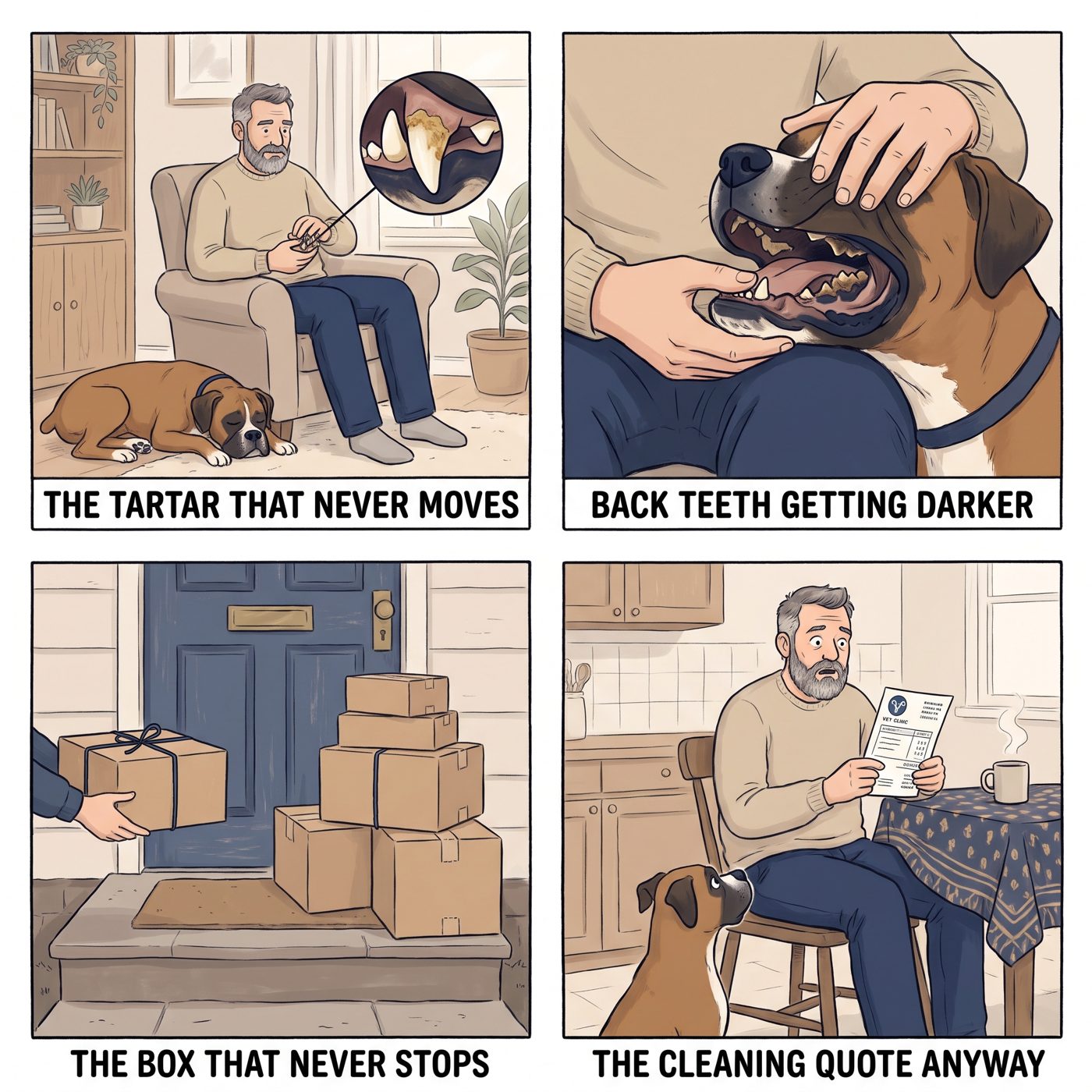
- 01 · The tartar that never moves: it's not that you weren't consistent enough, it's that the product was never built to touch what's already there.
- 02 · The back teeth that keep getting darker: it's not that your dog has bad teeth, it's that the crust is mineral, and mineral only comes off mechanically.
- 03 · The subscription that never ends: it's not that the product is too expensive, it's that you'll be buying it forever, by design.
- 04 · The cleaning quote anyway: it's not that the vet is upselling you, it's that the hardened tartar was always going to need a mechanical solution.
The chew is doing what it was tested to do, slowing new plaque on a surface that is already covered.
Why it started years ago, and why it gets worse
The crust started the day his adult teeth came in, one thin layer at a time, and by age three most dogs already show signs of it.
Tartar is rough, so fresh plaque sticks to it faster, which is why it hits small dogs hardest (Evidence 06), with tightly packed teeth and more corners to settle in.
Every month you wait, the layer gets thicker and rougher, and the only option left on the table becomes the one with anesthesia.
Why the chews kept the numbers steady but never cleaned the tooth
To be fair, they did exactly what they were designed to do: the job was always "slow it down," and the owner was quietly led to believe it was "clean it up."
So the teeth never get better, and the crust sits there until a vet writes up a quote.
The whole aisle, one product at a time
- Dental chews slow new plaque and rarely reach the back teeth.
- Water additives reduce new plaque chemically, and can't dissolve mineral.
- Dental powders and food toppers slow new build-up, and the existing crust doesn't move.
- Enzymatic toothpaste works on soft plaque, and can't break calculus.
- Dental wipes remove the fresh film, and do nothing against the hard layer.
- Sprays and gels coat the surface, and have to be reapplied every day.
- Rope and rubber toys rub fresh plaque, and never reach hardened tartar.
- Finger brushes handle daily plaque, not what's bonded to the tooth.
None of them is designed to remove tartar that has already hardened, and every one of them has to be bought again.
The conversation is changing, and dog parents were right
For years, owners who said "these don't seem to do anything" were told to be more consistent. They weren't wrong, because a "helps control" product never claimed to remove that crust, and their eyes were telling them the truth.
So what does hardened tartar actually need?
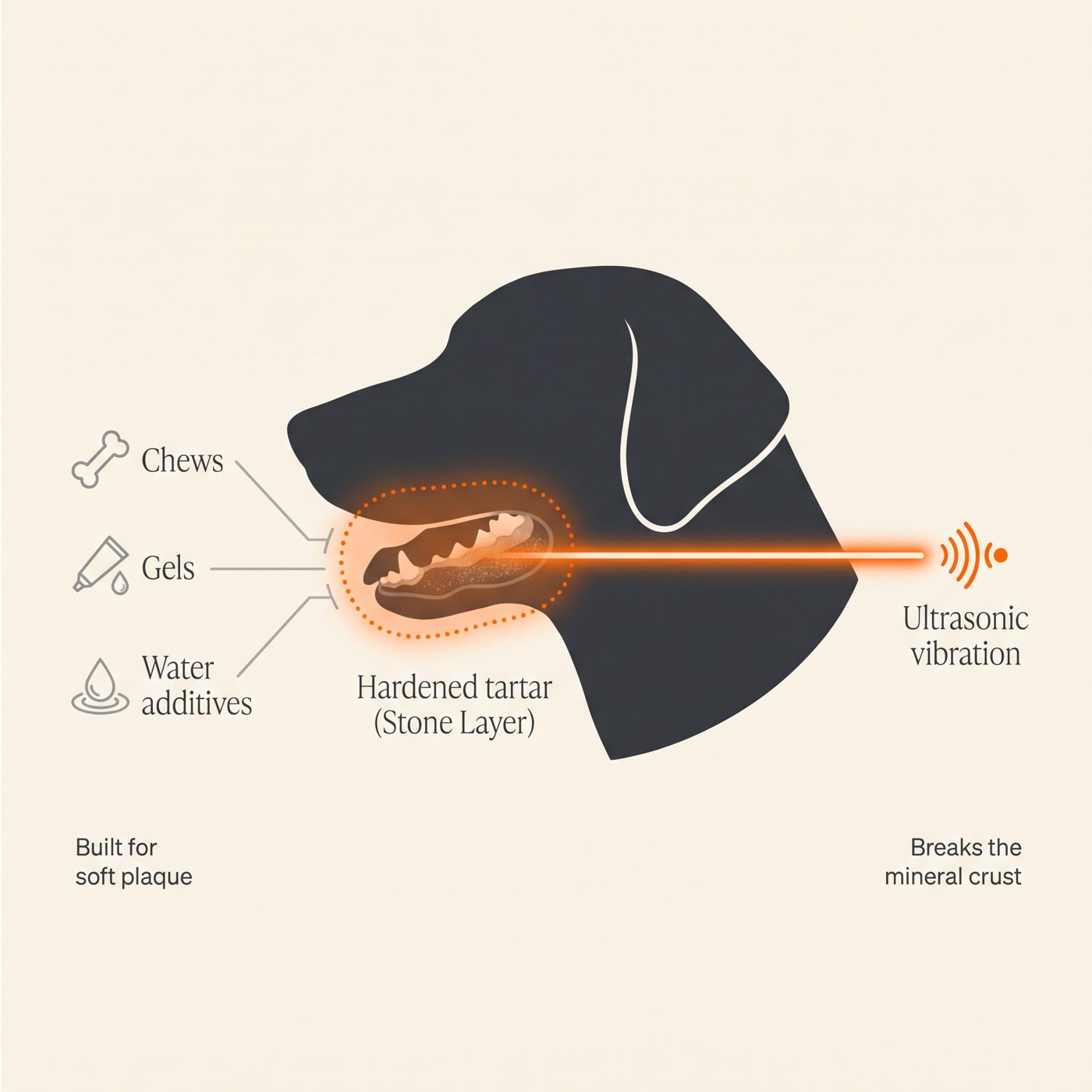
Tartar is mineral, so it has to be broken off physically, and vets do it with an ultrasonic scaler, a fine tip that vibrates thousands of times per second. It happens under anesthesia because clinic scalers are loud, powerful and made for a dog who isn't moving.
So Canivet rebuilt that same principle for a calm dog lying next to you on the couch: quiet enough not to scare him, small enough for a Chihuahua's mouth, and smart enough to stop the moment it touches the gum.
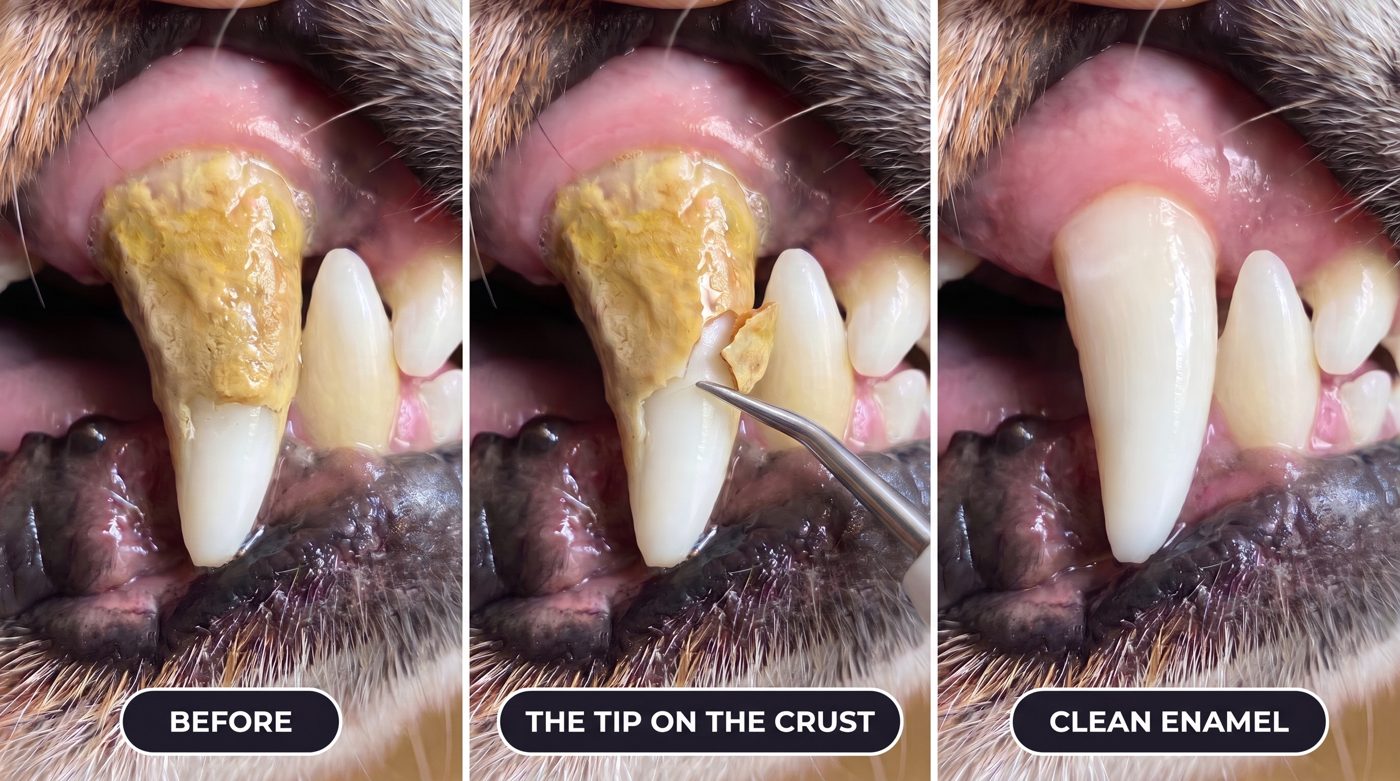
You rest the tip on the tartar, it cracks and flakes off, and the white enamel is right there underneath, with no anesthesia and no "use daily" small print.
Watch It Come Off
Same tooth, same dog, one session: the crust, the tip resting on it, and the clean enamel underneath.
One thing should be said plainly
Canivet doesn't replace your vet or your dog's checkups, and a dog in pain or with a swollen mouth needs a vet visit. What it does is very concrete: it removes the hardened tartar you can see on your dog's teeth, at home, without putting him under.
It's also not a subscription: you buy it once, and there's nothing to reorder every month.
What dog parents reported after one month
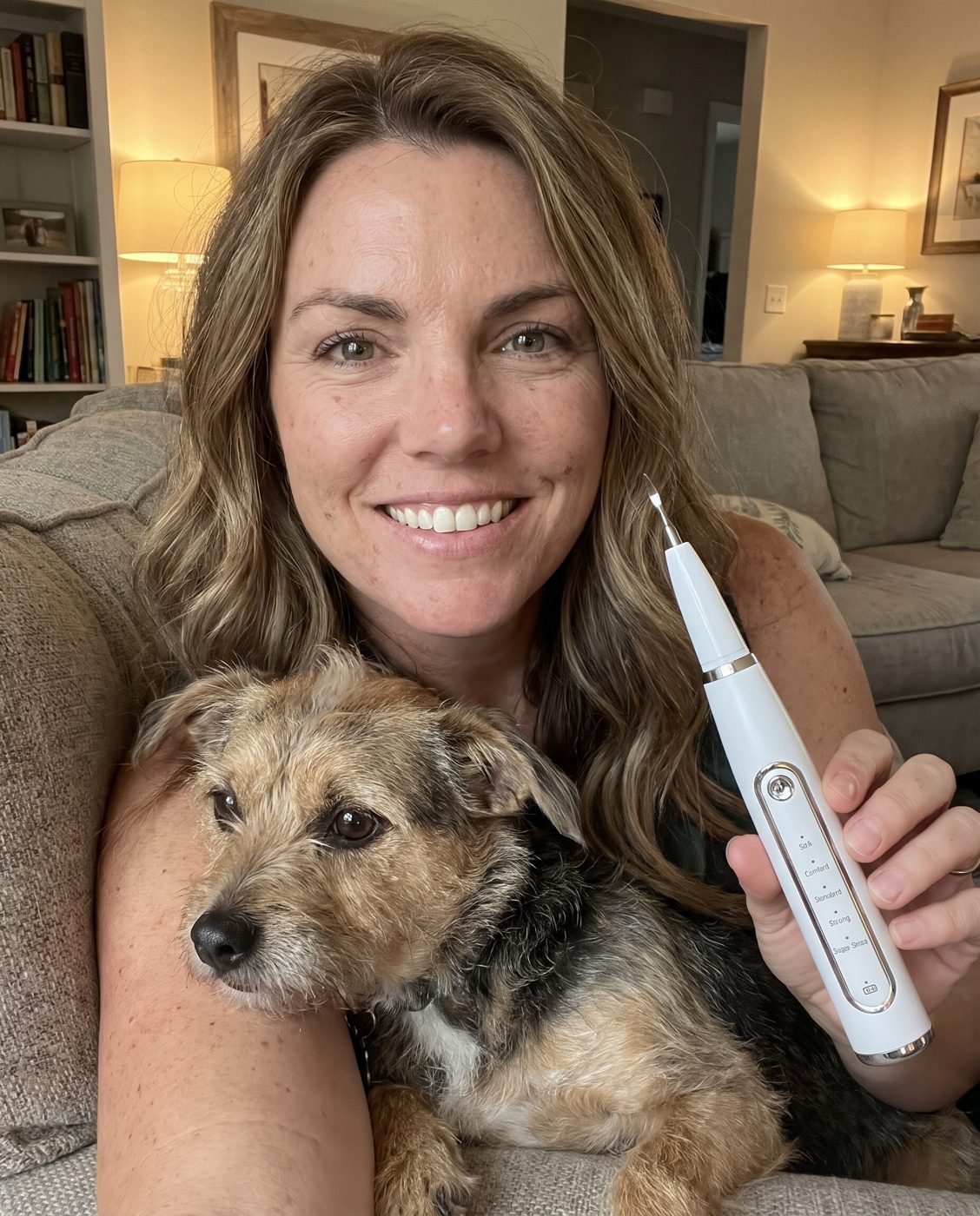
Here's what 112 Canivet customers reported after a full month:
- 88% reported a visible improvement in their dog's dental hygiene
- 83% reported less tartar
- 85% said their dog adapted to it easily
- 91% would recommend it to another dog parent
100K+
dog parents trust Canivet, rated 4.8 stars.
What's inside, and why each part matters
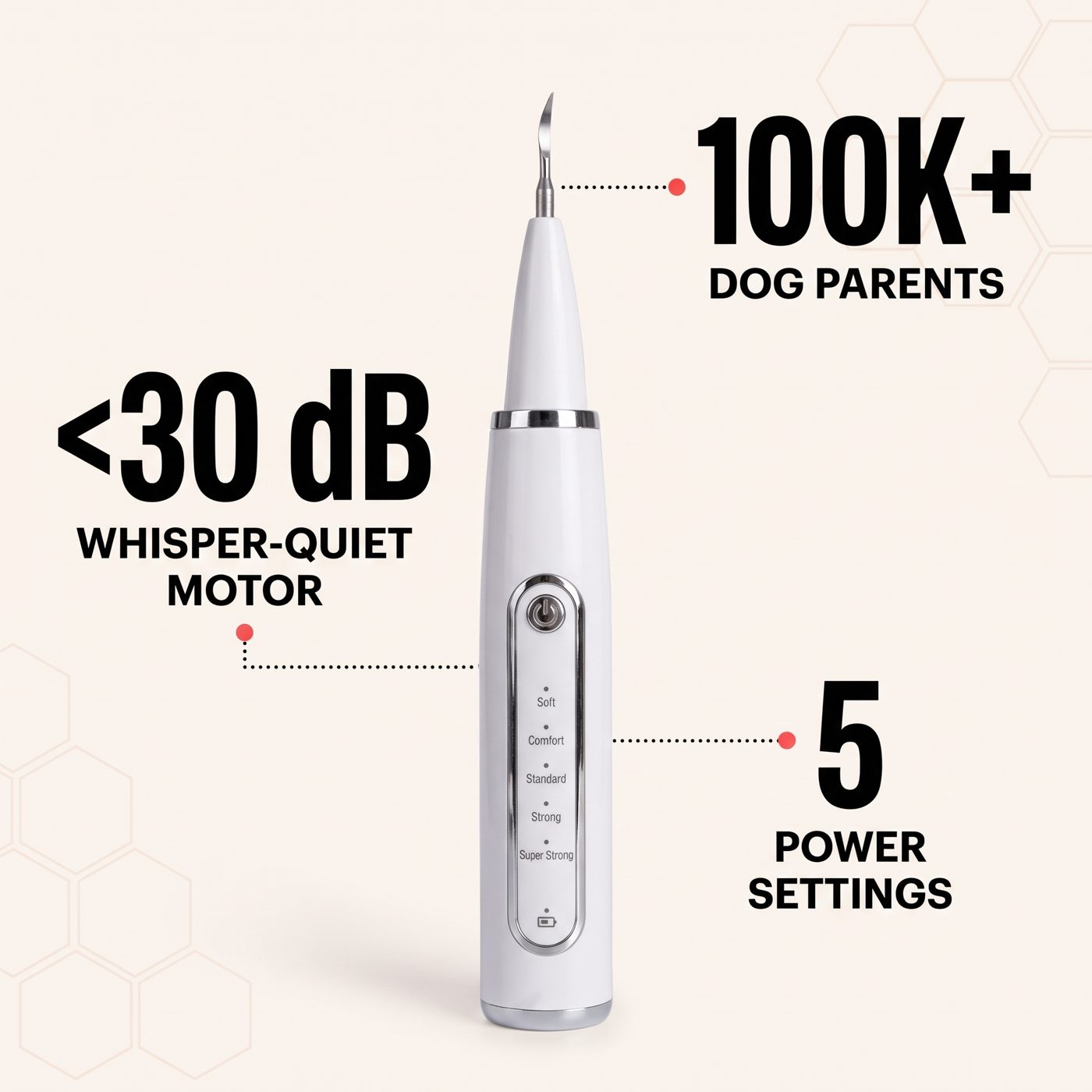
- Ultrasonic vibration: it breaks hardened tartar, the same principle as the clinic scaler.
- Gum sensor: the tip stops as soon as it touches soft tissue, so you can work right up to the gum line.
- Motor under 30 dB: about as quiet as a whisper, so most dogs stay relaxed.
- 5 settings (Soft, Comfort, Standard, Strong, Super Strong): start gently, then go up for the thick crust on the back teeth.
- LED light: it shows exactly where the tartar is at the back of the mouth.
- Small tip: it fits every mouth, from toy breeds to large dogs.
- About 30-day battery: charge it once and forget about it for a month.
How to use it
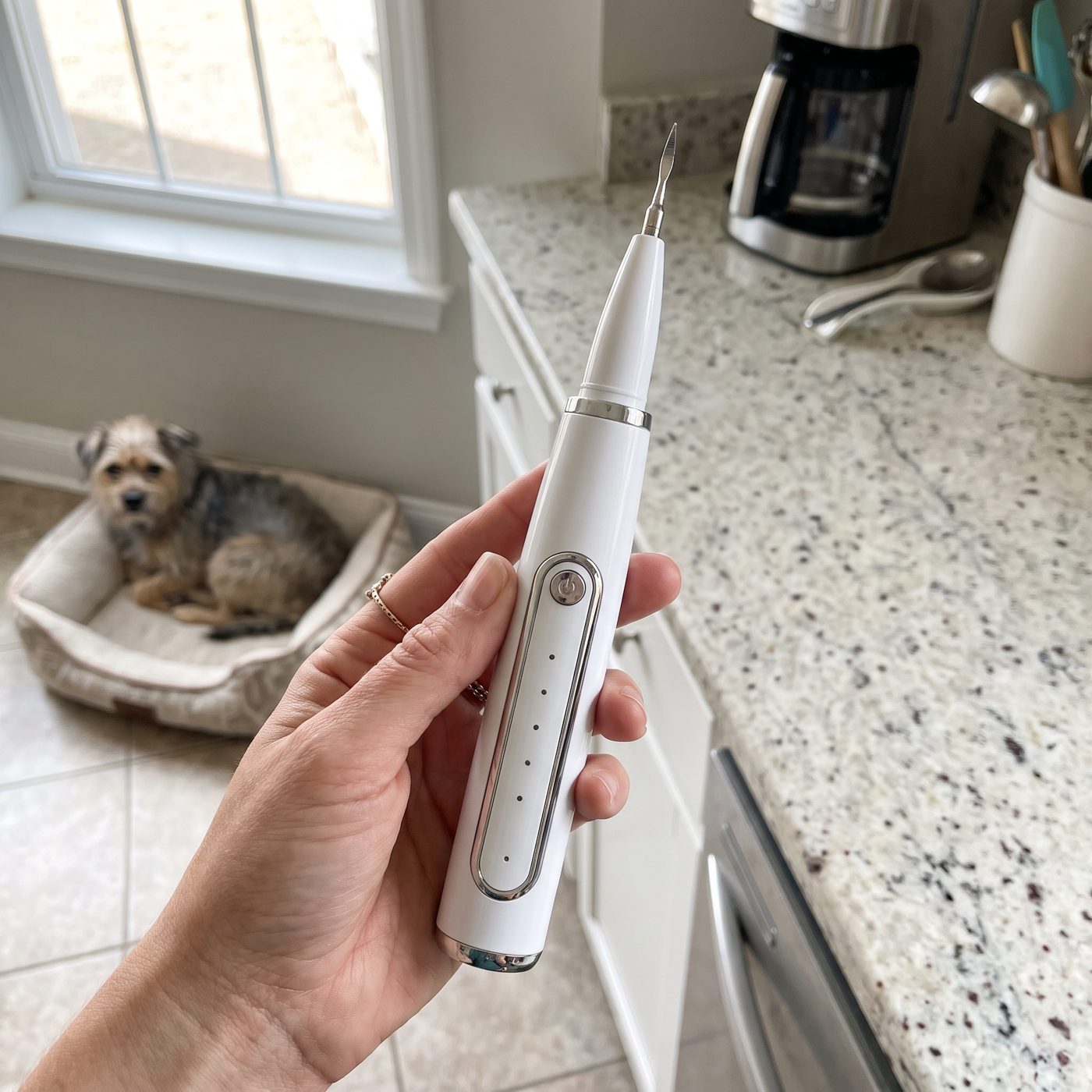
Pick a calm moment, start on Soft with a few front teeth, and work toward the back over the next sessions. If he loves his chew, keep it as a treat, just stop paying for it to do a job it was never designed for.
Right now Canivet is $60 off, with a free gift and free shipping on every order. You buy it once, instead of $660 a year in chews that never touched the crust.
The 60-day results guarantee: use Canivet for 60 days, and if you don't see results, we'll refund you.
Why it gets harder every month you wait
Every few days a new layer hardens on top of the last. Today the crust is the thinnest it will ever be again, and the easiest it will ever be to break off at home, before the next vet visit turns it into a quote with anesthesia attached.
What dog parents are saying
★★★★★ 4.8 / 5 · Trusted by 100K+ dog parents
“This was much easier to use than I expected. It worked very well and saved me an expensive trip to the vet for a teeth cleaning for my dog… This cleaner was very gentle and worked quickly to remove the tartar on my dog's teeth. It was so gentle that my dog fell asleep while I was using it to clean.”
Sara · Canivet customer“It provides a thorough cleaning which is so essential to my dogs health! So many people have noticed my dogs white teeth- I am so satisfied with this product!”
Peggy O. · Canivet customer“I was really impressed with how well this worked. I used on my little dog's teeth where I saw build up. I was able to remove a good deal of it at the top of his teeth. I used the lowest setting, too.”
Janice M. · Canivet customerWhy it's hard to find
Canivet isn't sold in big-box pet stores, only at TryCanivet.com. It's made in small batches, and when a batch sells out, it disappears from this page until we restock, so if the button below still says available, this batch hasn't run out yet.